


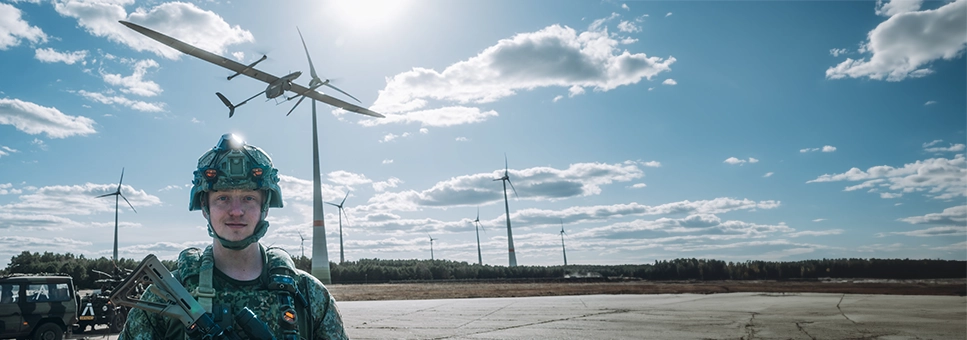
From the Field: EOS C VTOL
In the heart of Exercise Bastion Lion, the Dutch Army’s largest annual field exercise, Sergeant Jessey and his team from the 42nd Armoured Infantry Battalion Limburgse Jagers deployed a critical ISR asset: the Eos C VTOL unmanned aerial system.
Read the original articleThe Eos C VTOL has been in operational use since August 2024, providing persistent aerial surveillance and reconnaissance for the battalion’s real-world training missions. Their role during the exercise was to capture and hold the urban environment of Schnöggersburg, a complex and constrained scenario where situational awareness is essential and maneuver space is limited.
The user feedback was clear: "We can hardly operate without drones anymore. With only a 15-meter radius required for vertical takeoff and landing, we can fly nearly anywhere."
What made the Eos C VTOL so impactful for the unit?
- Rapid deployment & compact footprint: no catapult needed, just a 15-meter clear zone, and the drone is airborne within minutes.
- The UAS lifts vertically and transitions to forward flight for battery efficiency and extended range. This hybrid propulsion enables longer missions from tighter spaces.
- In field conditions, the team consistently achieved over 2.5 hours of operational endurance. It's more than most comparable systems in its class.
- Equipped with eOpic-5, a 30x EO zoom camera and thermal imaging, the Eos C VTOL allowed real-time target tracking and reconnaissance up to 8 km away, day or night.
- Lightweight, two-person operation: only a small team was needed to launch, operate, and recover the system, which is perfect for dismounted infantry ISR operations.
This isn’t about specs, it’s about a system that delivers trust through performance. The Eos C VTOL earned its place not because it was assigned, but because it proved itself in missions where ISR can change outcomes.